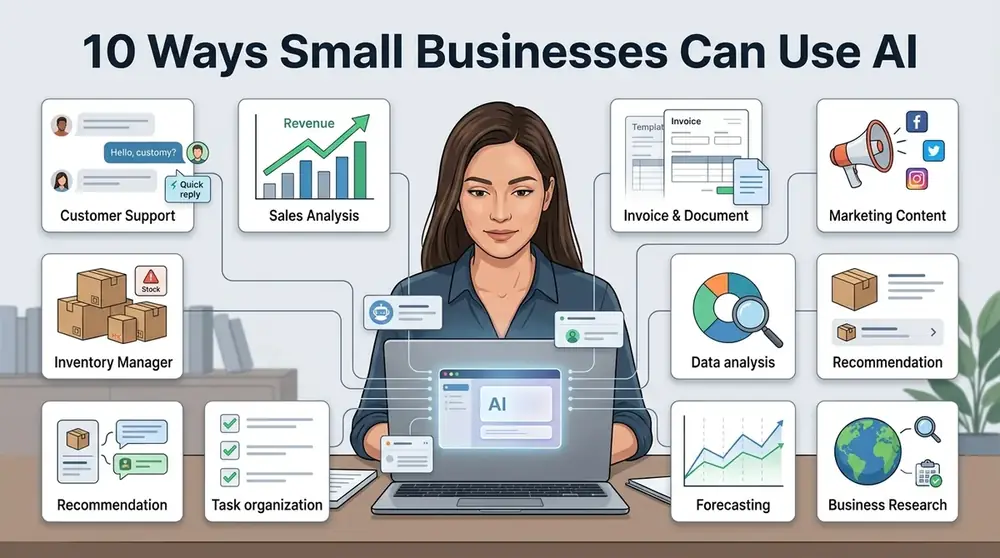
10 Ways Small Businesses Can Use AI
Introduction
Start with one repetitive business task
In today's generation, AI is becoming an increasingly useful tool for businesses. If you think AI is only for large companies, then you are completely wrong. Small businesses can also use AI for everyday tasks such as writing marketing content, answering customer questions, analyzing business data, handling invoices, and managing repetitive work.
AI can help save time, reduce work pressure, reduce some repetitive errors, and create more consistent workflows. However, it should be used as a tool that supports people rather than something that removes the need for human judgement.
A useful research point: a 2025 QuickBooks survey found that among small businesses using AI, common uses included marketing (43%), customer service (36%), administrative tasks (33%), data processing (32%), and bookkeeping (29%).
Here are 10 practical ways small businesses can use AI.
1. Use AI for Marketing and Social Media
Create useful drafts, then add your business voice
Small businesses can use AI to create marketing content more efficiently. Instead of creating every piece of content from scratch, AI can help generate ideas, drafts, variations, and supporting material.
AI can help small businesses create and manage marketing content without needing a large marketing team.
For example, AI can help create:
- Social media post ideas
- Captions
- Blog topic ideas
- Product descriptions
- Advertisement copy
- Email campaigns
- Marketing images
- Content calendars
Research shows that content creation and marketing are among the common small-business AI applications. One 2025 small-business technology survey found that 43% used AI for content writing and creation, 36% for image creation, and 32% for social media management.
2. Use AI for Customer Support
AI chatbots can help answer repetitive customer questions, including questions outside normal business hours.
For example, AI can answer questions such as:
- What are your opening hours?
- Do you deliver?
- What is the price of this product?
- Where is my order?
- How can I book an appointment?
IBM identifies customer service as one of the major business applications of AI, particularly for answering routine questions and providing support across websites and messaging platforms.
AI does not necessarily replace employees. A business can use AI to handle simple questions and redirect complicated questions, complaints, or unusual situations to an employee.
3. Use AI to Analyze Business Data
Small businesses can collect a large amount of information but may not have enough time to analyze it manually. AI can help summarize information and identify patterns that deserve attention.
AI can help analyze:
- Sales
- Revenue
- Expenses
- Customer purchases
- Product performance
- Website traffic
- Marketing results
The ICIC survey found that 26.8% of surveyed small businesses reported using AI for data analysis, making it one of the more common applications.
For example, an AI system could analyze sales records and identify which products sell the most, which months have higher demand, or where sales have declined. The owner can then review those findings before making a business decision.
4. Use AI for Bookkeeping and Invoice Management
Financial administration can involve many repetitive tasks. AI can help reduce some of the manual work involved in organizing and reviewing financial information.
Possible uses include:
- Reading invoices
- Extracting information from bills
- Categorizing expenses
- Organizing financial documents
- Tracking payments
- Finding unusual transactions
- Preparing financial information for review
Bookkeeping was reported as an AI use by 29% of small businesses in the QuickBooks survey.
5. Use AI for Inventory Management
Inventory management is particularly important for retailers, shops, restaurants, wholesalers, and other businesses that maintain physical stock.
AI can examine previous sales and other business information to help estimate future demand.
For example, a grocery store may notice that a particular product sells much faster during certain months. AI can analyze previous sales patterns and help the owner estimate how much stock may be needed.
Possible benefits include:
- Reducing overstocking
- Reducing stockouts
- Identifying popular products
- Estimating demand
- Improving purchasing decisions
However, AI predictions are estimates. Unexpected demand, supplier problems, seasonal changes, promotions, or other events can make actual sales different from the prediction.
6. Use AI for Sales and Lead Management
AI can help businesses organize and manage potential customers, especially when the number of leads becomes difficult to handle manually.
For example, AI can help:
- Organize leads
- Identify high-potential leads
- Summarize customer conversations
- Suggest follow-up messages
- Track customer interactions
- Help sales teams prioritize prospects
AI marketing and sales systems can also analyze customer activity and segment customers according to behavior and potential interest.
This can help sales employees spend more time on promising opportunities instead of manually sorting every customer record.
7. Use AI for Email and Communication
Small business owners and employees can spend a significant amount of time writing and replying to emails and messages. AI can assist with drafting, summarizing, proofreading, and organizing communication.
AI can help with:
- Customer emails
- Follow-up messages
- Appointment reminders
- Business announcements
- Internal communication
- Email replies
- Proofreading
The ICIC research found that 23.4% of surveyed small businesses used AI for drafting emails and other communication.
For example, an owner could provide the important information from a customer message and ask AI to prepare a professional draft. The owner can then review the draft before sending it.
8. Use AI for Administrative Tasks
Small-business owners often spend time on repetitive administrative work that does not directly generate revenue but is still necessary for running the business.
AI can help with:
- Meeting summaries
- Document summarization
- Data entry assistance
- Creating reports
- Organizing information
- Scheduling
- Transcribing conversations
- Creating standard documents
The ICIC report found that small businesses are already using AI for routine tasks such as data analysis, communication, blog writing, editing, meeting summaries, and web content summaries.
The main benefit is not that every administrative task becomes fully automatic. Instead, AI can reduce the amount of repetitive work employees have to complete manually.
9. Use AI to Understand Customers
Understanding what customers want is important for almost every business. AI can help analyze customer reviews, feedback, surveys, support conversations, purchase history, and other customer information.
Instead of manually checking hundreds of reviews or support conversations, businesses can use AI to summarize the information and identify common patterns.
For example, a business receives hundreds of complaints and reviews. AI could summarize the most common negative complaints and positive feedback.
This can help the business owner understand which products receive the best feedback, which products have recurring problems, and which issues customers mention most frequently.
AI can also support personalization and product recommendations by analyzing customer behavior and purchase history.
10. Use AI as a Business Assistant
Use AI for planning while keeping final judgment human
AI can also act as a general business assistant. It can help owners brainstorm ideas, organize plans, summarize research, and explore different approaches to business problems.
For example, AI can help with:
- Business ideas
- Market research
- Competitor research
- Business plans
- SWOT analysis
- Pricing ideas
- Customer research
- Marketing strategies
- Brainstorming
- Creating action plans
The ICIC survey found that 20.1% of surveyed small businesses reported using AI for strategic planning and 20.4% for market exploration.
Conclusion
AI does not have the ability to completely replace employees or automatically solve every business problem. Instead, it can become a useful tool for handling repetitive work and helping people work more efficiently.
For a small business, a practical starting point is to use AI for a few repetitive or time-consuming tasks. This can allow the owner and employees to spend more time on customers, business growth, decision-making, and work that requires human judgement.
The best approach is to start small. Choose one time-consuming task, use AI to assist with it, measure whether it actually saves time or improves the workflow, and then decide whether to expand its use.
Shopify's current small-business guidance similarly groups practical AI applications around areas such as customer service, data analytics, marketing, operations, sales, and product development.
Frequently Asked Questions
What is the most important first step?
Start with one clear, measurable improvement related to this topic, then review the result regularly.
How often should a small business review this?
A monthly review is a practical starting point. Review sooner when costs, customers, products, or processes change significantly.
Can software replace business judgment?
No. Software can organize information and automate repeatable work, but people should verify important information and make final decisions.
Article tags
QuickGENBiz
Turn good ideas into reliable workflows.
Manage invoices, inventory, customer credits, and business records from one practical platform.
Get started free