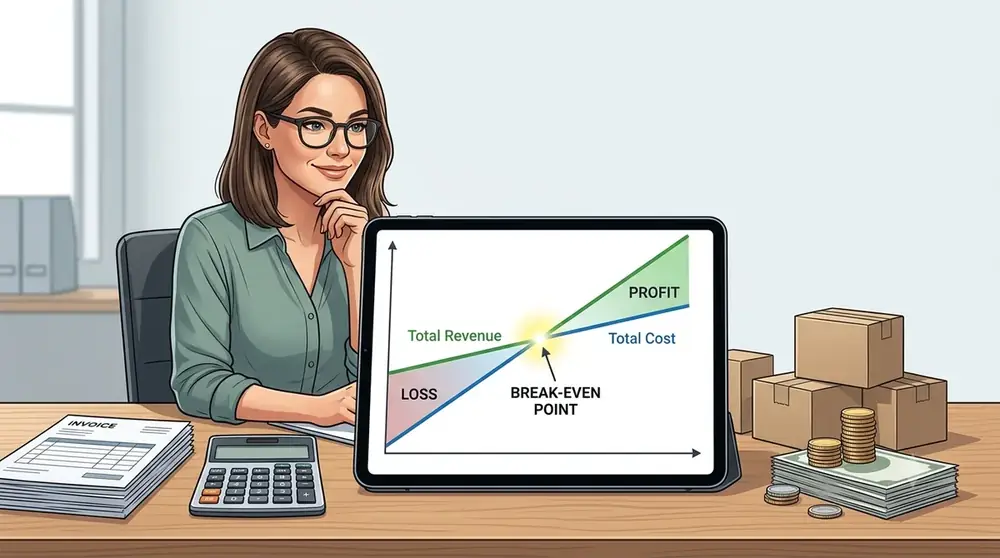
Strong sales can hide weak profits. If you mix rent and payroll with product costs, you may sell more while keeping too little money from each sale.
The break-even point shows the sales volume needed to cover total costs before your business earns a profit. This guide explains break-even analysis, fixed and variable costs, contribution margin, sales targets, and common errors.
Why break-even analysis matters before your next business decision
Break-even analysis gives you a clear sales target. You can use it before changing prices, hiring staff, launching a product, buying equipment, signing a lease, or increasing a marketing budget. It also supports better profit planning for small businesses because each decision changes either fixed costs, variable costs, or both.
The result is a planning estimate, not a promise. It depends on your selling price, costs, expected sales mix, demand, and available capacity. The SBA's break-even guidance describes break-even analysis as an estimate and notes that it does not replace accounting or financing calculations after costs occur.
Understand what the break-even point measures
Your business reaches break-even when total revenue equals total costs. At that point, profit is zero and operating loss is zero. Sales above the break-even level can create profit, while sales below it can create a loss.
You can measure break-even in units, sales revenue, or time. For example, you might need to sell 300 products per month, generate $24,000 in monthly revenue, or reach annual break-even by a certain month.
Connect break-even analysis to cash flow
Break-even does not tell you whether cash is available today. A business may show a profit while waiting for customers to pay, carrying expensive inventory, or making loan payments.
Decide what your analysis includes before calculating it. You may include owner pay, taxes, interest, loan payments, depreciation, maintenance, and one-time costs. Pair the result with a cash-flow forecast, budget, and tax plan.
Separate fixed and variable costs before using the formula
A wrong cost split creates a wrong break-even point. Start with bookkeeping records, payroll reports, invoices, bank statements, supplier prices, and payment processor reports instead of rough guesses.
Identify fixed costs
Fixed costs stay fairly stable during the period you choose. Common examples include rent, salaried wages, insurance, software subscriptions, professional fees, licenses, equipment leases, and base utility charges.
“Fixed” applies to a time period. Rent may stay unchanged for a year, then rise after a lease renewal. A business can also add a new fixed cost when it hires an employee or opens another location.
Identify variable and mixed costs
Variable costs rise with each unit, order, project, or client. They may include materials, inventory, packaging, per-order shipping, payment fees, sales commissions, subcontractor payments, and delivery tied to a sale.
Mixed costs contain fixed and variable parts. Phone plans, fuel, repairs, utilities, and tiered software often fit this category. Separate the base charge from usage costs when your records allow it. Also check for refunds, discounts, spoilage, shrinkage, customer support, maintenance, and unpaid owner labor.
Calculate the break-even point for a small business
Once costs are sorted, calculate the contribution margin. This is the amount left from each sale after its variable cost. That amount first covers fixed costs and then contributes to profit.
Calculate contribution margin
Use these formulas:
| Measure | Formula |
|---|---|
| Contribution margin per unit | Selling price per unit - Variable cost per unit |
| Contribution margin ratio | Contribution margin per unit ÷ Selling price per unit |
Suppose a handmade candle sells for $40 and costs $16 in materials, packaging, and payment fees. The contribution margin is $24, and the contribution margin ratio is 60% ($24 ÷ $40).
Contribution margin is not always the same as gross profit. The result depends on how your accounting system classifies labor, overhead, and production costs.
Calculate units and sales revenue
The main break-even formulas are:
Break-even units = Total fixed costs ÷ Contribution margin per unit
Break-even sales revenue = Total fixed costs ÷ Contribution margin ratio
Use matching periods. Monthly fixed costs produce a monthly result; annual fixed costs produce an annual result. If fixed costs are $7,200 per month and the contribution margin is $24, the business must sell 300 candles to break even. At $40 each, break-even sales revenue is $12,000.
Round unit results up to the next whole unit. A result of 300.2 means 301 units.
Apply break-even analysis to prices and profit goals
The calculation becomes more useful when you connect it to daily sales decisions. Convert the result into weekly sales, client counts, billable hours, or revenue targets your team can track.
Calculate target profit and margin of safety
To reach a target profit, use:
Required units = (Fixed costs + Target profit) ÷ Contribution margin per unit
Required sales revenue = (Fixed costs + Target profit) ÷ Contribution margin ratio
If fixed costs are $7,200 and your target profit is $2,400, divide $9,600 by the $24 contribution margin. You need 400 candles. State whether the target is before or after taxes.
Margin of safety shows how far sales can fall before losses begin:
Margin of safety in dollars = Actual or projected sales - Break-even sales
Margin of safety percentage = Margin of safety dollars ÷ Actual or projected sales × 100
A larger margin gives you more room for a sales decline, but no percentage guarantees safety.
Test price and cost changes
Lowering your price usually reduces contribution margin and raises required sales volume. Cutting variable costs lowers break-even volume when the selling price stays the same. Adding rent, payroll, equipment, or advertising raises fixed costs and increases the break-even point.
Run current, higher-price, lower-cost, lower-sales, and expansion scenarios. This shows whether a proposed change depends on extra demand your business cannot serve.
Adapt the formula to real small-business models
The standard formula works best with one product and a stable price. Real businesses often need a more careful definition of a “unit.”
Service, subscription, and recurring-revenue businesses
For a service provider, one unit may be an appointment, project, retainer, consultation, or billable hour. Include subcontractor pay, project materials, travel, rework, cancellations, and other job-related costs. Compare break-even billable hours with available hours and your target utilization.
For subscriptions, divide monthly fixed costs by customer contribution margin. Customer contribution margin equals recurring revenue per customer minus customer-specific costs, such as payment fees, onboarding, support, discounts, and usage charges. Churn changes the customer count, while acquisition capacity limits how quickly you can reach it.
Businesses with multiple products
One product formula can mislead a retailer with different margins. Calculate a weighted-average contribution margin based on the expected sales mix, then document that mix. If customers shift toward lower-margin products, recalculate the result.
Businesses with unpredictable sales mixes should also track separate break-even points by product category. The SBA calculator guidance explains that businesses may need separate calculations when product or service sales vary by month.
Avoid errors and build a repeatable worksheet
Do not divide fixed costs by selling price alone when each sale has meaningful variable costs. Revenue is the amount collected, while contribution margin is revenue minus variable costs. Label every figure with its period and unit so you do not mix monthly costs with annual sales.
Use current supplier quotes, payroll data, payment fees, discounts, refunds, and recent sales records. Prepare conservative, expected, and optimistic scenarios because demand, wages, inflation, repairs, inventory, and competitor actions can change the result.
A worksheet should include the analysis period, fixed costs, selling price, variable cost per unit, contribution margin, contribution margin ratio, break-even units, break-even revenue, target profit, and required sales.
In a spreadsheet, formulas can mirror the calculations:
Contribution margin = Price - Variable cost
Break-even units = Fixed costs / Contribution margin
Break-even revenue = Fixed costs / Contribution margin ratio
Review the worksheet monthly or quarterly, and after changes to prices, suppliers, payroll, rent, commissions, marketing, or product mix.
Compare actual revenue, units, fixed costs, variable costs, and contribution margin with your forecast. The difference points to a pricing, volume, cost, mix, or assumption problem.
Common questions about calculating break-even point
What is the easiest break-even formula?
Use:
Fixed costs ÷ (Selling price per unit - Variable cost per unit)
The figures must cover the same period and reflect a fairly consistent price and cost structure.
Is break-even the same as profitability?
No. Break-even means revenue equals costs, so profit is zero. Sales must exceed break-even to create operating profit. Account separately for taxes, financing costs, and desired owner compensation.
How often should a small business recalculate break-even?
Review it monthly or quarterly, based on business size and cost volatility. Recalculate after meaningful changes to pricing, supplier costs, payroll, rent, commissions, marketing, or sales mix.
Conclusion
To calculate the break-even point for a small business, gather current financial data, separate fixed and variable costs, find the contribution margin, and apply the unit or sales-revenue formula. Then add target-profit goals, margin-of-safety measures, and several price and cost scenarios.
Build a worksheet using your latest month or quarter of data. Compare the required sales level with your capacity and forecast demand, then set a review date so the benchmark stays useful.
Article tags
QuickGENBiz
Turn good ideas into reliable workflows.
Manage invoices, inventory, customer credits, and business records from one practical platform.
Get started free