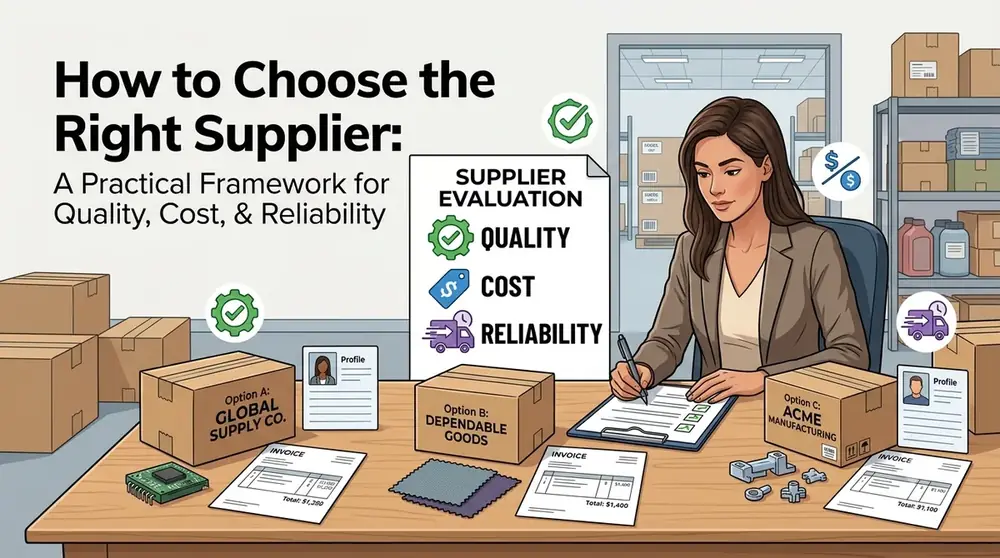
How to Choose the Right Supplier
A supplier can affect your product quality, cash flow, customer satisfaction, and ability to keep selling. The lowest quote may create higher costs through late deliveries, defects, poor communication, rework, or weak service.
The right supplier supports growth. The wrong one creates the same problems every month. A structured supplier selection process helps manufacturers, retailers, wholesalers, and service firms compare vendors with clear evidence. It combines supplier evaluation, vendor due diligence, procurement controls, supplier qualification, and supplier relationship management.
How to Choose the Right Supplier With a Clear Brief
Turn business needs into supplier requirements
Write your requirements before requesting quotes. Include product dimensions, materials, performance standards, packaging, labeling, customization, order volumes, delivery locations, and required licenses or certifications.
Separate non-negotiable requirements from preferences. Share one supplier requirements document with every vendor so each quote answers the same questions. This prevents price from becoming the only basis for your decision.
Match capacity with demand
Review forecasted demand, minimum order quantities, lead times, seasonal peaks, and expected growth. Ask whether the supplier can handle larger orders without reducing quality or extending delivery times.
Check production capacity, staffing, equipment, inventory practices, and subcontracting. Your supplier should explain how it will meet current demand and what changes it would make as your business grows.
Build a Weighted Supplier Scorecard
A scorecard keeps personal preference and sales pressure from controlling the decision. Give each factor a weight based on business risk rather than treating all criteria equally.
Useful categories include:
- Quality and consistency
- Total landed cost
- Lead time and delivery history
- Capacity and financial stability
- Compliance and ethical practices
- Communication and technical support
- Sustainability and after-sales service
For a critical component, quality and continuity may receive the highest weights. For a routine office purchase, price and delivery may matter more. Record evidence beside each score, including test results, references, contract terms, and due-diligence findings.
Evaluate Supplier Quality and Capability
Verify systems and certifications
Do not rely on a logo or a downloadable certificate. Check the certificate number, issuing body, expiry date, scope, and facility address through an official certification database or accredited testing organization.
ISO 9001:2015 remains the current published edition as of August 2026, according to the International Organization for Standardization . It provides a quality-management framework, but certification does not remove the need to test the supplier’s actual products. Also confirm industry licenses, regulatory approvals, product tests, and location-specific requirements.
Test samples and inspect operations
Assess samples for materials, dimensions, function, durability, finish, labels, packaging, and consistency. Before a large order, document the approved sample, tolerances, inspection method, defect classes, testing duties, and process for rejected goods.
Ask for an onsite or virtual facility tour when the purchase carries meaningful risk. Review machinery, quality checkpoints, maintenance, staff skills, storage, and internal production. Confirm which work is outsourced and whether subcontractors meet the same requirements.
How to Choose the Right Supplier by Total Cost
Calculate the full landed cost
Compare more than the unit price. Include tooling, setup fees, samples, packaging, freight, insurance, customs duties, taxes, inspection, storage, currency conversion, and likely rework.
- Start with the quoted unit price.
- Add shipping, duties, taxes, storage, and inspection.
- Include setup, packaging, currency, and likely rework costs.
Request an itemized quote with minimum order quantities, volume breaks, exclusions, assumptions, and a validity period. This makes supplier pricing easier to compare and exposes costs that may appear after the purchase order.
Review payment and price-change terms
Check deposits, balance payments, credit terms, milestone payments, currency, refunds, and late-payment rules. A large upfront payment can strain working capital and increase risk before you approve production.
Ask how the supplier handles raw-material changes, surcharges, expedited shipping, engineering changes, cancellations, returns, warranty claims, and open orders. Add advance notice and a clear approval process for price changes.
Confirm Reliability and Supply-Chain Resilience
Check delivery and communication records
Ask for delivery performance, lead-time history, shipping methods, tracking tools, references, and escalation contacts. Find out how the supplier handled a past delay, shortage, quality failure, or urgent order.
Test communication before signing. Send detailed questions and judge whether replies are timely, clear, consistent, and supported by documents. Confirm time-zone coverage, language needs, account ownership, technical help, and order-confirmation procedures.
Review continuity plans
Ask about backup facilities, alternate materials, safety stock, disaster recovery, cyber incidents, labor shortages, transport disruption, and financial pressure. Find out how quickly the supplier will notify you when a risk appears.
For high-risk purchases, qualify a second source or keep a written contingency plan. The U.S. Federal Acquisition Regulation offers a useful comparison: responsible contractors should have financial resources, production equipment, delivery ability, quality controls, and a satisfactory performance record, while the lowest price alone can create false savings. See FAR Subpart 9.1 .
Complete Supplier Due Diligence Before Signing
Check credentials and responsible practices
Verify the legal business name, ownership, operating sites, bank details, years in business, insurance, trade references, and available financial information. Use business registries, credit providers, trade groups, and professional advisers when the purchase is large or sensitive.
Review labor standards, forced-labor risks, environmental permits, waste handling, anti-bribery rules, data protection, and conflict-mineral controls. The European Commission explains that supply-chain due diligence should identify, prevent, reduce, and account for actual or possible harm; its due-diligence guidance also supports risk-based reviews and third-party audits where suitable.
Treat refusal to provide basic records, frequent bank changes, or pressure to bypass controls as warning signs. Match the depth of review to the purchase value, legal duties, and effect of failure.
Protect the agreement
Your supplier agreement should define specifications, inspection rights, delivery commitments, price, payment, intellectual property, confidentiality, warranties, returns, recalls, insurance, liability, dispute resolution, termination, and change control.
Add measurable service levels and remedies for missed commitments. Legal review makes sense for international, regulated, strategic, or high-value contracts.
Select, Onboard, and Monitor the Supplier
Compare evidence and run a trial order
Bring together scorecard results, sample tests, commercial terms, due-diligence checks, and feedback from finance, operations, quality, and sales. Negotiate for better lead times, payment terms, flexibility, guarantees, and escalation rules, not only a lower price.
Start with a controlled trial order. Set success criteria for quality, packaging, documents, delivery, communication, and issue resolution before increasing volume.
Track performance after approval
Monitor on-time delivery, defect rate, order accuracy, lead-time variance, response time, corrective-action completion, returns, and price changes. Hold regular supplier reviews and record each action, owner, deadline, and result.
Re-evaluate after an ownership change, factory move, material change, regulation update, repeated delay, or major quality failure. Supplier relationship management works best when performance records guide fair, timely decisions.
Conclusion
The right supplier is the one that delivers dependable value across quality, cost, delivery, compliance, communication, and future capacity. A low quote cannot compensate for defects, missed orders, cash-flow strain, or customer complaints.
Define your requirements, build a weighted scorecard, verify quality systems, test samples, assess capacity, calculate landed cost, review resilience, complete due diligence, and sign clear terms. Then test the relationship with a controlled order and monitor measurable supplier KPIs.
Document why you chose the supplier, retain qualified alternatives where disruption would hurt customers, and treat supplier performance as an ongoing business responsibility.
Frequently Asked Questions
What is the most important first step?
Start with one clear, measurable improvement related to this topic, then review the result regularly.
How often should a small business review this?
A monthly review is a practical starting point. Review sooner when costs, customers, products, or processes change significantly.
Can software replace business judgment?
No. Software can organize information and automate repeatable work, but people should verify important information and make final decisions.
Article tags
QuickGENBiz
Turn good ideas into reliable workflows.
Manage invoices, inventory, customer credits, and business records from one practical platform.
Get started free