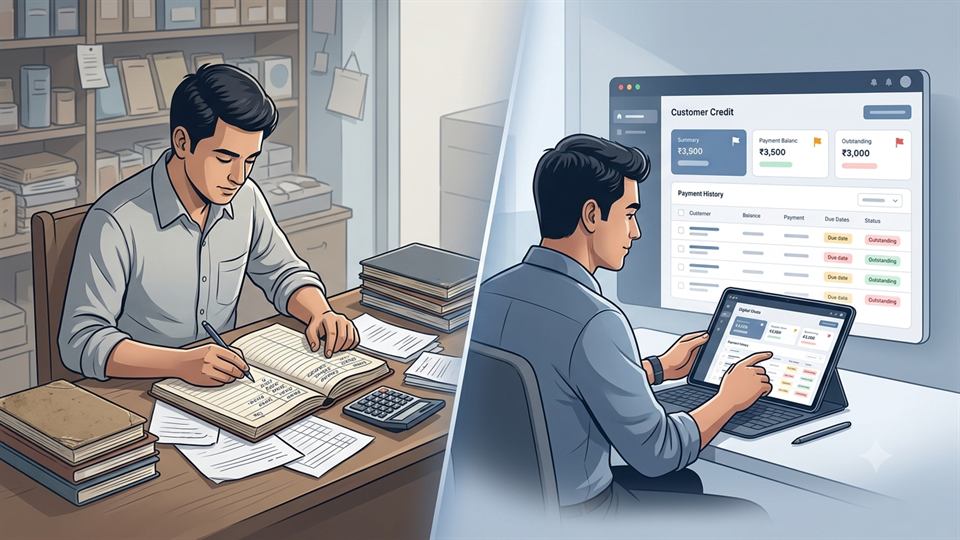
A customer takes goods today and promises to pay next week. You write the amount in a notebook, ledger, or mobile app. That small choice can affect collections, cash flow, customer trust, and your confidence when someone disputes a balance.
The digital khata vs traditional khata decision matters more as credit sales grow.
A digital khata may suit a busy shop with many customers, frequent payments, and several staff members. A traditional khata may work well for a small local business with a few trusted buyers and poor internet access.
The better option depends on transaction volume, customer habits, device access, staff skills, privacy needs, and reporting needs.
Key Takeaways
- Digital khata can make searching, calculations, reminders, and reporting faster.
- Traditional khata requires no battery, app, internet connection, or technical setup.
- Digital records still require accurate entries, secure accounts, and reliable backups.
- Paper records can work well for very small businesses with few trusted credit customers.
- A controlled hybrid system can make the transition from paper to digital easier.
- The best system is the one that improves accuracy and collections without making daily work harder.
Digital Khata and Traditional Khata Solve the Same Problem Differently
Both systems track money that customers owe and payments they make. They help retailers, wholesalers, repair shops, service providers, and other credit-based businesses keep a record of each account.
What a traditional khata records
A traditional khata is a handwritten credit book. It usually includes the customer's name, transaction date, goods or service supplied, credit amount, payments received, remaining balance, and a promised payment date.
Many owners add short notes beside each entry. These notes may record a phone call, a partial payment, or an agreement to settle the account after payday.
The system is direct, familiar, and easy to start.
How a digital khata changes daily recordkeeping
A digital khata uses a mobile app, web tool, or business accounting app to record credit sales and payments. It can calculate running balances, save customer histories, add timestamps, search old entries, and create statements.
Some digital ledger tools also track supplier balances. For example, OkCredit's business ledger app says it records customer receivables and supplier payables, with shareable statements and collection reports.
This makes a digital credit book more useful than a basic list of customer debts.
Why small businesses are moving beyond handwritten ledgers
Paper records become harder to manage when entries happen all day. Owners may spend time checking pages, adding figures, and searching for an old transaction while a customer waits.
Government business guidance also stresses accurate records of income, expenses, debts, and money owed to the business. Businesses can keep records on paper, digitally, or through bookkeeping software as long as the records remain accurate and complete.
Digital Khata vs Traditional Khata at a Glance
| Factor | Digital Khata | Traditional Khata |
|---|---|---|
| Calculations | Usually automatic | Manual |
| Search | Fast and searchable | Requires checking pages |
| Internet | Often required or useful | Not required |
| Backup | May support cloud backup | Manual copies required |
| Reminders | Often available | Manual |
| Reporting | Usually easier | Manual calculations |
| Setup | Requires device/app setup | Very simple |
| Offline use | Depends on the app | Yes |
Digital Khata Delivers Speed, Visibility, and Easier Collections
Digital tools offer their biggest gains when a business handles many credit accounts. They reduce routine work and make outstanding balances easier to see.
Automated calculations reduce balance errors
A digital khata can add new credit, subtract payments, update balances, and attach a date and time to each transaction.
This reduces mistakes caused by mental arithmetic, unclear handwriting, or missed updates.
Automation is not a substitute for checking
Automation helps, but it cannot fix a wrong entry. If you record the wrong amount or select the wrong customer, the app will still show an incorrect balance.
Searchable records make customer follow-up faster
You can search a customer's name and review the full account history without checking several notebooks.
This helps settle disputes because you can see dates, amounts, and payments during the conversation.
Some services also create downloadable statements. OkCredit, for instance, lists PDF account statements and monthly collection reports among its features.
Khatabook's official platform also lists business reports, device syncing, automatic backup, and access across mobile and desktop.
Digital reminders improve payment follow-up
Many khata apps offer SMS, WhatsApp, or in-app reminders. Some allow customers to pay through a link or UPI, while others only send a message.
Use reminders as a polite prompt, not a threat. Check the amount before sending, give customers a clear contact option, and avoid repeated messages that harm a good business relationship.
Traditional Khata Still Works When Simplicity and Control Matter Most
Paper remains practical for some businesses. A notebook needs no battery, app account, internet connection, or training session.
Paper records work without devices or internet access
A paper khata keeps working during power cuts, weak mobile signals, device failures, or app outages.
It also helps owners who serve customers in places with limited digital access.
The drawback is that paper has no automatic backup. A lost, wet, burned, or stolen notebook may remove the only record of months of credit sales.
Familiar workflows require little training
An owner, family member, or long-time worker may already know how to use a handwritten ledger.
A small shop with ten regular credit customers may not gain enough value from a paid app to justify changing its routine.
Paper can also feel more private because the record stays in the shop. That privacy only exists if the notebook is stored securely and kept away from customers or unauthorized staff.
Physical ledgers create risks that must be managed
Unreadable handwriting, skipped pages, duplicate entries, delayed updates, and forgotten payments can weaken a paper system.
Use one entry format, number each page, check balances daily, and store the book in a locked, dry place.
Write every payment at once. A weekly review can catch missing entries before they turn into a customer dispute.
Digital Khata and Traditional Khata Differ Most in Cost, Security, and Accuracy
The cheapest tool is not always the lowest-cost system. You must count the time spent recording, checking, finding, and collecting money.
Compare direct costs with manual work
Digital khata costs may include app subscriptions, premium reports, mobile data, a reliable phone, staff access, and payment-processing charges.
Some apps have free plans, while paid features may include more reminders, multiple users, or advanced reports.
Traditional khata costs less to start. Still, you pay through notebooks, pens, storage, manual calculations, staff time, and possible losses from forgotten or disputed credit.
Evaluate privacy, access, and data security
A digital record needs a screen lock, strong account password, limited staff access, and regular backups.
The UK's National Cyber Security Centre recommends strong passwords, two-step verification, device locks, software updates, and removing accounts that former staff no longer need.
Paper records face different threats. Anyone near the notebook may read customer information, while fire, water, theft, or careless storage can destroy it.
Keep only the information you need and protect it in either format.
Accuracy depends on process as well as technology
Digital tools may provide timestamps, edit histories, backups, and reports.
Paper systems can still stay accurate with daily reconciliation and periodic ledger reviews.
Neither method records a payment that you forget to enter. Keep personal credit separate from business credit, confirm each payment, and match cash received with khata entries before closing each day.
The Best Choice Depends on Business Size, Credit Volume, and Customer Habits
The right khata fits the way your business already works. A high-volume store needs different controls than a small repair service with a handful of regular customers.
Choose digital khata when transactions are frequent or customers are numerous
Consider digital khata if you record credit throughout the day, manage many active accounts, need quick balance reports, or send regular payment reminders.
It also helps when more than one person records sales.
A digital system becomes more useful as the business adds staff, branches, suppliers, or product categories.
Check whether the app supports exports, backups, user permissions, and the payment methods your customers use.
Choose traditional khata when operations are small and highly local
Paper may be enough when one owner manages a small number of trusted customers and records only a few credit transactions each day.
It can also suit a business with unreliable internet or limited access to smartphones.
Review this choice if customers increase, disputes become common, or you spend too much time searching for balances.
Use a hybrid system during the transition
A hybrid approach can help during a careful switch. Use paper during outages or at the counter, then enter each transaction into the digital system at a fixed time.
Choose one official record for balances. Reconcile paper and digital entries daily or weekly, and never allow two conflicting totals to continue.
Which Khata Should You Choose?
Choose Digital
Best when you have many customers, frequent transactions, regular collections, or multiple people managing records.
Keep Traditional
Practical for a very small operation with few trusted customers and limited technology access.
Go Hybrid
Useful during a transition when you need paper as a backup while establishing a digital record system.
A Simple Evaluation Framework Reveals Which Khata Fits Better
A short test can reveal more than general claims about apps or notebooks. Score your real work, not your hoped-for growth.
Score the business on five practical criteria
Rate each area from low to high: daily transaction volume, number of credit customers, collection frequency, need for reports, and technology reliability.
High scores in the first four areas support digital khata, while low scores and weak connectivity may support paper.
| Criterion | Low score suggests | High score suggests |
|---|---|---|
| Daily transactions | Traditional may be enough | Digital becomes more useful |
| Credit customers | Few accounts to manage | Searchable records become valuable |
| Collection frequency | Occasional follow-up | Frequent reminders and tracking |
| Reporting needs | Simple balances | Reports and summaries needed |
| Technology reliability | Weak connectivity or device access | Reliable device and internet |
Run a two-week pilot with one product group or a selected set of customers. Track entry speed, balance accuracy, staff use, customer comfort, reminder results, and the time needed to find old transactions.
Set non-negotiable recordkeeping rules
Record every sale immediately. Confirm payments, separate personal and business credit, back up digital data, review overdue balances, and reconcile cash with khata entries each day.
For any app, check its privacy terms, export options, backup process, and access controls before entering customer information.
Digital or Traditional: Follow These Recordkeeping Rules
- ✓ Record every credit transaction immediately.
- ✓ Record every repayment against the correct customer.
- ✓ Keep personal and business credit separate.
- ✓ Review overdue balances regularly.
- ✓ Reconcile records with actual payments.
- ✓ Protect customer information from unauthorized access.
- ✓ Maintain a backup when using digital records.
Conclusion
Digital khata usually offers faster searches, automatic calculations, reminders, reports, and easier growth.
Traditional khata offers low setup effort, familiar handling, and offline access.
Neither method protects the business if entries are late, incomplete, or poorly checked.
Choose digital khata when credit activity is growing and you need clear cash-flow visibility. Choose traditional khata for a very small, stable operation with few accounts.
Use a controlled hybrid system if you are moving from paper to digital.
Start by listing active credit customers and reviewing the last month of transactions. Mark every missing entry, balance dispute, delayed collection, and time-consuming search.
Then choose the system that improves accuracy and collection discipline without making daily work harder.
Simplify business management
Manage credits and everyday business tasks in one place
QuickGENBiz helps small businesses manage important daily operations with simple tools for invoices, inventory, credits, and more.
Tags
Frequently Asked Questions
What is a digital khata? ⌄
A digital khata is an electronic system for recording customer credit, payments, balances, and account history. It may be provided through a mobile app, website, or business accounting platform.
What is a traditional khata? ⌄
A traditional khata is a handwritten ledger used to record customer credit sales, payments, balances, dates, and notes. It does not require a device, app, or internet connection.
Is digital khata better than traditional khata? ⌄
It depends on the business. Digital khata is generally more useful for businesses with many customers, frequent transactions, regular collections, or reporting needs. Traditional khata may be sufficient for a small operation with few trusted customers.
Can a traditional khata work without internet? ⌄
Yes. A paper khata does not require internet, electricity, a smartphone, or an app, which can make it useful in areas with unreliable connectivity.
What are the main benefits of a digital khata? ⌄
Common benefits include searchable customer histories, automatic balance calculations, digital statements, reminders, backups, reports, and easier management of a growing number of credit accounts.
Can I use a digital and traditional khata together? ⌄
Yes. A hybrid system can be useful during a transition or during temporary outages. However, choose one official record for customer balances and reconcile the two systems regularly to prevent conflicting totals.